Ethics Week 4: It’s 2020. Where is Your Work?

Uncategorized

This week, I’ve been reading up on archival and maintenance systems, with a special eye to digital scholarship. How do we store and maintain things? How are systems designed to facilitate their own updates, and to keep their contents both safe and accessible?


What I’m talking about has a couple of different aspects attached to it, since there are a lot of different factors in data storage. Here are some quick questions to ask when it comes to archiving your work:

  • Who is the entity organizing this storage?
    Different entities store different data for different reasons and in different ways. Consider: Google Books, the Gould Library, JSTOR, the Internet Archives

  • What types of information are being stored?
    Consider file formats, storage limits, and what types of information the storing body might prioritize (and why).

  • When was this system created, and how is it being maintained?
    Digital systems require maintenance, just like physical ones. Old websites are hard to navigate; outdated software can cause security issues.

  • Where is your information stored, and where is it accessible?
    Is your paper being paywalled? Can the people who need to find it, find it? And conversely, is the storing entity capable of secure storage?

  • Why is this entity storing your information?
    Have they expressed a commitment to the long-term accessibility of knowledge? Do they have a profit motive (and, if they lose profits, will that commitment waver)?

  • How is this entity demonstrating their commitment to preserving information?
    Are they transparent with their motives, their methods, and their means? Are they likely to waver in difficult times?


No system is perfect, but looking to an entity’s motives and methods can be particularly illuminating. Also worth investigating is how comparable companies that have shut down dealt with their records, whether they kept them after closing down, and whether those items are still accessible by their creators, or by the general public.


Vine, for example, hosted short videos which could be made through its phone app, but went defunct after struggling to find a way to consistently monetize its content. The site still has videos available to view and to download, but people can no longer post new videos, and I couldn’t find a source on whether creators can remove their old videos or control who can see them.


Moving forward, I’ll continue looking into how digital systems are maintained and what they might store; this will also tie into a side project I’m working on, where I will be researching the history of the internet.

Ethics Week 2: Laying the Groundwork

Uncategorized

This being the second in a series of weekly blog posts, intended to edify the public on the various goings-on within the ethical strata of the Digital Scholarship community of Carleton, particularly with regards to…

I kid, I kid. Here’s a quick catch-up on what I’ve been doing this week!

The process of my work has been primarily logistical, getting up and running for the rest of term. I’ve been exploring various topics, deciding which ones are worth pursuing, and solidifying them into project ideas and questions to answer. I’ve determined four projects/areas of research, two major and two supporting, which I’ve outlined below and which feed into each other in various ways.

After some exploration, my common question for this term will be regarding the tradeoffs between organizational affordances in the cloud, and data security. This will consist of testing various organizational systems, seeing what conveniences they offer and what drawbacks, and researching how this data is stored and what it might be used for. I will also be keeping an eye on project logistics and multi-person information/storage systems, because my major project will center around open source software.

The Digital Scholarship Interns’ winter 2019 project will consist of revamping our website and, in the process, exploring the history of collaboration, accessibility and performance in web design. Part of my job will be examining open source communities and how they work with each other, as well as how that workflow affects the final product of their projects and designs.

In addition, I will be following up on my earlier data security question by looking at some common sites used by colleges for logistical purposes, investigating their practices, and researching the laws being passed about data security which affect those sites. Some of the writeups on these topics may not be made public, but rest assured, I’m looking!

And finally, I will also be engaging in a side project of mine, which is to develop my coding skills, particularly in the programming language Ruby. I’m hoping to learn more about Ruby on Rails, and possibly use it in order to build a web-based presentation of my research for the DSI project.

Happy Week 2!

UXPA 2019 Reflections

Uncategorized

The theme for UXPA 2019 was, as far as I could tell, empathy. Empathy, caring and careful design, came up in as a refrain frequently, and when it wasn’t mentioned outright, it was implicit. This focus on thoughtfulness extended both within and without, which I found very interesting. I would expect a conference for UX Design to be, necessarily, concerned with the experience of others; I anticipated less the theme of kindness to oneself.

SPEAKER SUMMARIES

Keynote speaker Vivianne Castillo gave a talk titled “The Siren Call of Self-Neglect”, where she talked about the potential for burnout, and the necessity of self-care. While traffic meant we arrived partway through, I did manage to note down her focus on communication. She made two key points. Firstly, managers should make it clear that team members can be vulnerable with them, encouraging communication not just when things are going well but also when things are going poorly. Support systems can’t be built after they’re needed. Secondly, there’s no need to reinvent the wheel on discussions of ethics and other relevant fields. Those working in UX should explore other disciplines and talk to people working in those areas. Castillo also shared a Google Drive folder full of resources on self care and mindfulness, as well as some resources for white people who wish to educate themselves on racial privilege without burdening people of color. This folder is available in the supplemental materials below.

Abby Bajuniemi’s talk, “I don’t talk like that! Research Methods and Ethics for Natural Language Interaction”, was less an exploration of digital design and more an examination of experimental ethics and how we communicate. The speaker touched on the fact that language, despite being an arbitrary social construct, is still a factor in discrimination and can be used to uphold ideologies of race, gender, and other identities. She then went on to discuss the ethics of experimental design, particularly in conveying information about the experiment to the participants and in eliciting usable data without infringing on the subjects’ privacy rights. While Bajuniemi did not have strict recommendations regarding these ethical questions, she was firm in her policies: make it clear to participants what is being collected, how it will be stored, and how it can be accessed/who will have access. She suggested hiring an interpreter or translator if there is doubt that the participants will understand the experimenter fully. Her appearance on a linguistics podcast, also mentioned in her presentation, is included in the supplemental materials.

“Interruptions: Living in a World of Divided Attention” was the third presentation, given by Molly Hillstrom. Hillstrom outlined the cost of distractions in the workplace and in people’s personal lives, citing statistics regarding quality of work and mental health. This topic was integrated with the idea of design when Hillstrom called on designers to be careful, compassionate, and sparing in their use of notifications, to stop using features like autoplay and infinite scroll which make it easy for people to get ‘sucked in’, and to make it easy for people to adjust preferences which will help them not get distracted. There were no supplemental materials.

Ellen Lucast presented “Opportunities and Challenges in the Voice Interaction Space”, which discussed the potential work required for true voice interaction (creating conversations, rather than programs like Alexa and Siri which have designated responses for specific statements). Much of this presentation was theoretical, and went over my head in regards to its technical aspects, but my primary takeaway was what Lucast called Grice’s Maxims, a set of rules for communication. In quick, simplified summary, they are: be truthful; give the right amount of information; be relevant; be brief and orderly. These rules were interesting to me because of the tension they suggest between usefulness and kindness. Grice’s Maxims seem, on the surface, designed to facilitate useful communication, but they also seem to allow for conversations which are trustworthy, interesting, thoughtful and intelligible. While they are good design principles for practical reasons, they also continue the theme of thinking about users as people. No supplemental materials were included in the presentation.

McLean Donnelly’s presentation, “An Accessibility Case Study: Expedia”, outlined the initiative Donnelly took to help Expedia make its website more accessible. He gave a series of steps, which touched on initial proposals, research, an internal audit of the system, and the feedback and design cycle, among other aspects. These steps gave transparency and a good model to people who might wish to undertake similar initiatives at their own workplace. Donnelly’s work was a practical expression of the design philosophies at play throughout UXPA. He included multiple recommended resources to help practice and learn about accessible design, and recommended people draft accessibility policies for their organization as well as practicing skills-based volunteerism. His resources are listed in the supplemental materials.

Liz Tupper’s talk, “Empowering People through Tech”, discussed human-centric/empathetic design, and a design initiative that centered the needs of the users. She emphasized the need to listen to feedback given during the testing phases, and outlined four steps for empathetic design. First, engage with people in their own space; facilitate collaborative creativity; test and get feedback from the people you seek to help; and organize a support structure for the tech and for the people the tech is supposed to exist. This talk, like Donnelly’s, gave very practical examples of design steps and brainstorming practices, but these examples were centered more around getting ideas from the users the product was intended for. Tupper did not include supplemental materials, though her design exercises may be part of a future blog post.

Beth McKeever presented a talk called “Symbiotic Product Relationships”, which, rather than exploring empathy for the user or empathy for the self, discussed the ways in which UX designers can foster good working relationships with their coworkers, particularly their product managers. Her advice once more came down to communication. Knowing each others’ strengths and weaknesses, attending meetings together in order to facilitate detailed discussion, gaining comfort disagreeing with each other, and constructively talking about office culture were all things McKeever considered vital to a working relationship. In fact, she recommended overcommunicating when building a new relationship, in order to set up that foundation of openness. McKeever also mentioned a book on developing a culture, included in the supplemental materials.

The closing talk was given by Jeff Sussna, titled “Beyond the Designer as Auteur”. In contrast to some prior speakers, Sussna’s consideration for the user’s experience framed the experience as an ongoing service, rather than as a one-time consumable product. The example he gave was of food: a candy bar not only fills you up and tastes nice, but it also gives you energy that you take with you throughout your day. Ultimately, Sussna stated that design was less about features and more about outcomes. He also discussed complex/emergent systems, the potential for failure, and the need to lean into chaos and learning from a) system failures and b) the creative/unintentional uses consumers find for a product. My favorite part of this presentation was a quote of Sussna’s which I found both evocative and lovely: “What problems might our solutions create?” Sussna also recommended several books, which are listed in the supplemental materials.

PERSONAL TAKEAWAYS:

UXPA 2019 was a challenge for me to condense down to a few words on the ethics of UX. In part this was due to the fact that each speaker’s talk touched on ethics, but some did so obliquely or veiled through a different topic. The conference was less concerned with setting out specific ethical principles or guidelines, and more concerned with exploring the ways in which we treat people with respect and dignity. At the core, this is what designing experience should be: carefully considering the feelings, needs and rights of the person whose experience is being designed. While the nature of the conference placed emphasis on interaction through questions, I am looking forward to investigating the exercises and resources recommended by presenters which merge empathy with UX design.

SUPPLEMENTAL MATERIALS:

Vivianne Castillo:


“Vivianne’s UX Self-Care Resources”: bit.ly/uxselfcare

Abby Bajuniemi:


The Vocal Fries podcast, “Bilingualism isn’t Just for White Kids”: https://vocalfriespod.com/2019/04/16/episode-37-bilingualism-isnt-just-for-white-kids-shownotes/


McLean Donnelly:


Accessibility for Everyone, by Laura Kalbag: https://laurakalbag.com/book/

“UX Accessibility”, by Doug Collins through Skillshare: https://www.skillshare.com/classes/UX-Design-For-Accessibility/166696059

The Makery Group’s Accessibility Policy: https://www.themakerygroup.com/accessibility-policy.html


Beth McKeever:


The Culture Code: The Secrets of Highly Successful, by Daniel Coyle: http://danielcoyle.com/the-culture-code/


Jeff Sussna:


Design for Dasein, by Thomas Wendt: https://www.amazon.com/Design-Dasein-Understanding-Experiences/dp/1506166539/

How Do Committees Invent?, by Melvin E. Conway: http://www.melconway.com/Home/Committees_Paper.html

Drift Into Failure, by Sidney Dekker: https://www.amazon.com/Drift-into-Failure-Sidney-Dekker/dp/1409422216

Designing Delivery, by Jeff Sussna: https://www.sussna-associates.com/book


Fall 2019: A Term of [REDACTED]

Uncategorized

The common theme to my work as the Ethics Intern this term has been anonymization, particularly of data. The two projects taking the bulk of my attention both deal with the requirements of ethical data collection; one in a practical manner, one in a theoretical. First is my work with the Public Memory of Myanmar project, on behalf of Professor Tun Myint; second is my research into the Institutional Review Board and its requirements for Carleton.

The Public Memory of Myanmar project is an ongoing effort to document daily life in Burma/Myanmar, in various towns and cities around the country. The Carleton Political Science department sponsors an annual trip, organized by Tun Myint, where participants photograph and interview locals. Burma/Myanmar is a politically turbulent area, and the Public Memory exists in order to preserve ways of life that are in jeopardy and to put narratives of life into those people whose experiences may not be depicted in the official political narratives put out by the state. However, this political turbulence also means that local people participating in this project may be in danger if they can be identified. Much of my work this term has therefore consisted of going through each item in the collection (a photograph/video, accompanied by descriptive metadata) and combing through the information associated with each object in order to find any specific names or locations that could be used to identify individuals.

This focus on the particulars of individual data also comes up in my other major project, which has been to do research with regards to the Institutional Review Board at Carleton, the standards it must meet, and the standards it must uphold. The IRB is an overseeing body at Carleton that approves project proposals for work which involves research using human subjects. These proposals must explain what data they wish to collect, how they will collect it, and what their plans are for safe storage. These concerns come up most frequently with regards to the psychology and economics departments. However, it is definitely possible for other fields to propose projects that fall under the purview of the IRB. The regulations the IRB is subject to are relevant to the library and to digital scholarship because the library is responsible for the storage of data after it is collected by student researchers (it must be kept for a minimum of three years after the study is concluded, according to federal law). Carleton is also subject to GDPR regulations where data collection overlaps with GDPR jurisdiction (data collected in regards to people currently located in the EU falls under this jurisdiction). 

Ethical data collection under the IRB involves looking not only at which pieces of information are collected, but how these pieces might work together to identify an individual even if personal IDs are not collected. For example, while collecting college ID numbers or Social Security numbers would make participants easy to identify and therefore would not be allowable under the IRB, collecting, for example, age, gender, hometown and current dorm creates the potential to identify specific individuals by combining this information. Finding, for example, a 23-year-old woman from Albany living in a specific building is a distinct possibility based on collected data which the researcher might not even mean to use.

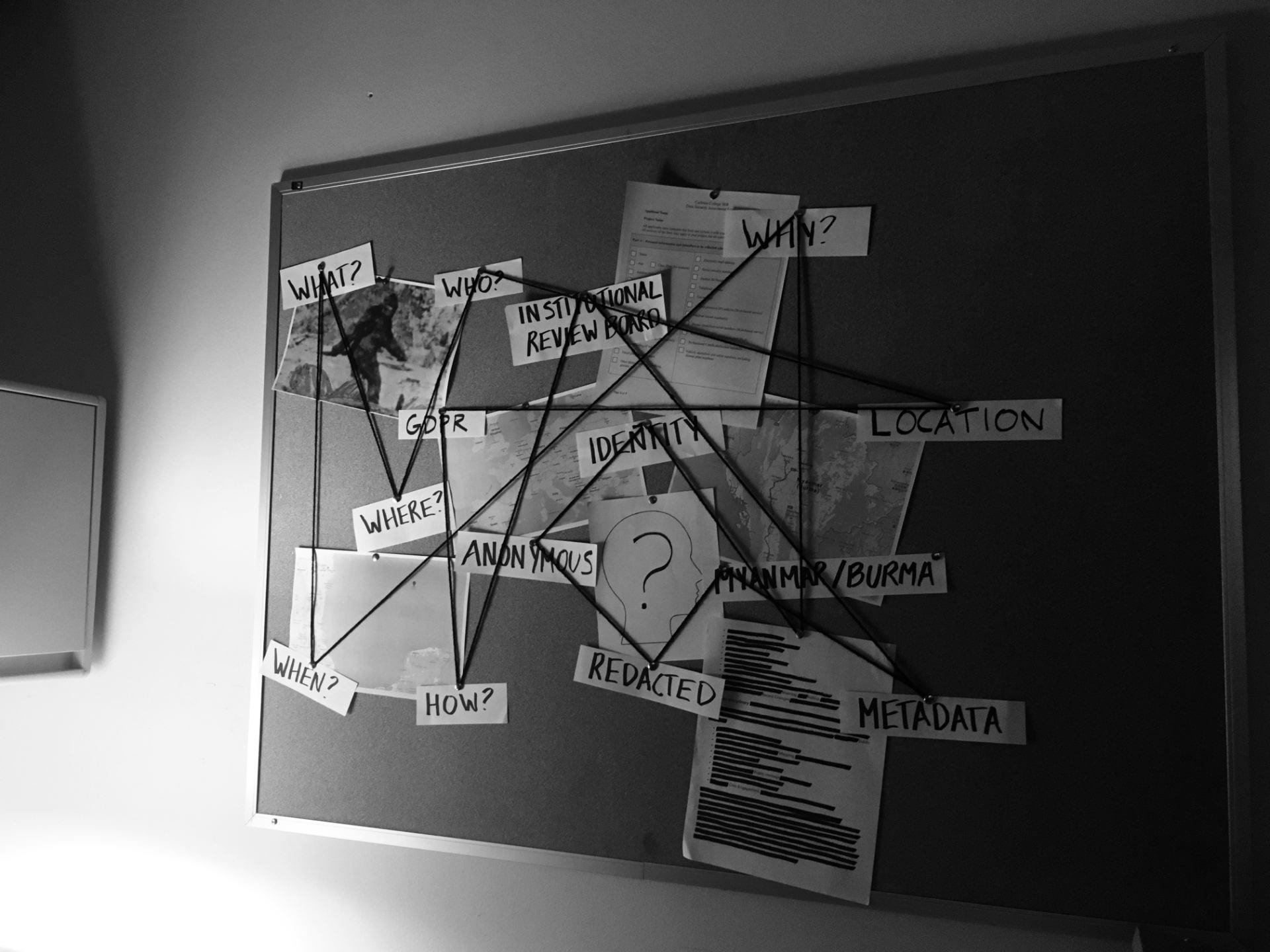
You can see why it’s been difficult for me to come up with a visual to convey the work I’ve done this term, since so much of my work centered on stripping away identity. In the end, what I settled for was somewhat tongue-in-cheek. Please enjoy Sanitized Data, by Pilot Irwin (2019).

Fall 2019 End of Term Blog Post

Uncategorized

This term I started my work as the back-end development intern. I dove into plugin development for content management systems, specifically WordPress and Omeka. I was able to gain lots of experience learning and coding in PHP, and better understand the capabilities of the language as a back-end development tool. Before starting plugin development, I had to familiarize myself with both WordPress and Omeka, which involved installing and setting up instances of both on my local MAMP environment, and playing around with the admin sides of both sites. Halfway through the term, I was also able to upgrade our omeka-development server to the latest version of Omeka so that we could test the new AccessibilityPlus features, which was great server administration experience for me. I also watched lots of tutorials on how to build websites with WordPress, and to learn how the WordPress code itself is structured and how plugins fit into it.


Once I was prepared to start coding, I learned that plugin development for content management systems is a fun and rewarding process, after an initial learning curve. Understanding how plugins fit into the regular processing of a CMS like WordPress using hooks and filters was a new kind of programming for me, and definitely took some getting used to. It was disorienting but also refreshing to not have to code every piece of functionality from scratch, but rather just use all of the functions and variables that already exist within the plugin’s environment. It makes the plugin code seem deceptively simple, because the real work is figuring out exactly which hooks or filters you want to use, which arguments you want to modify, and how built-in functions can make your life easier.

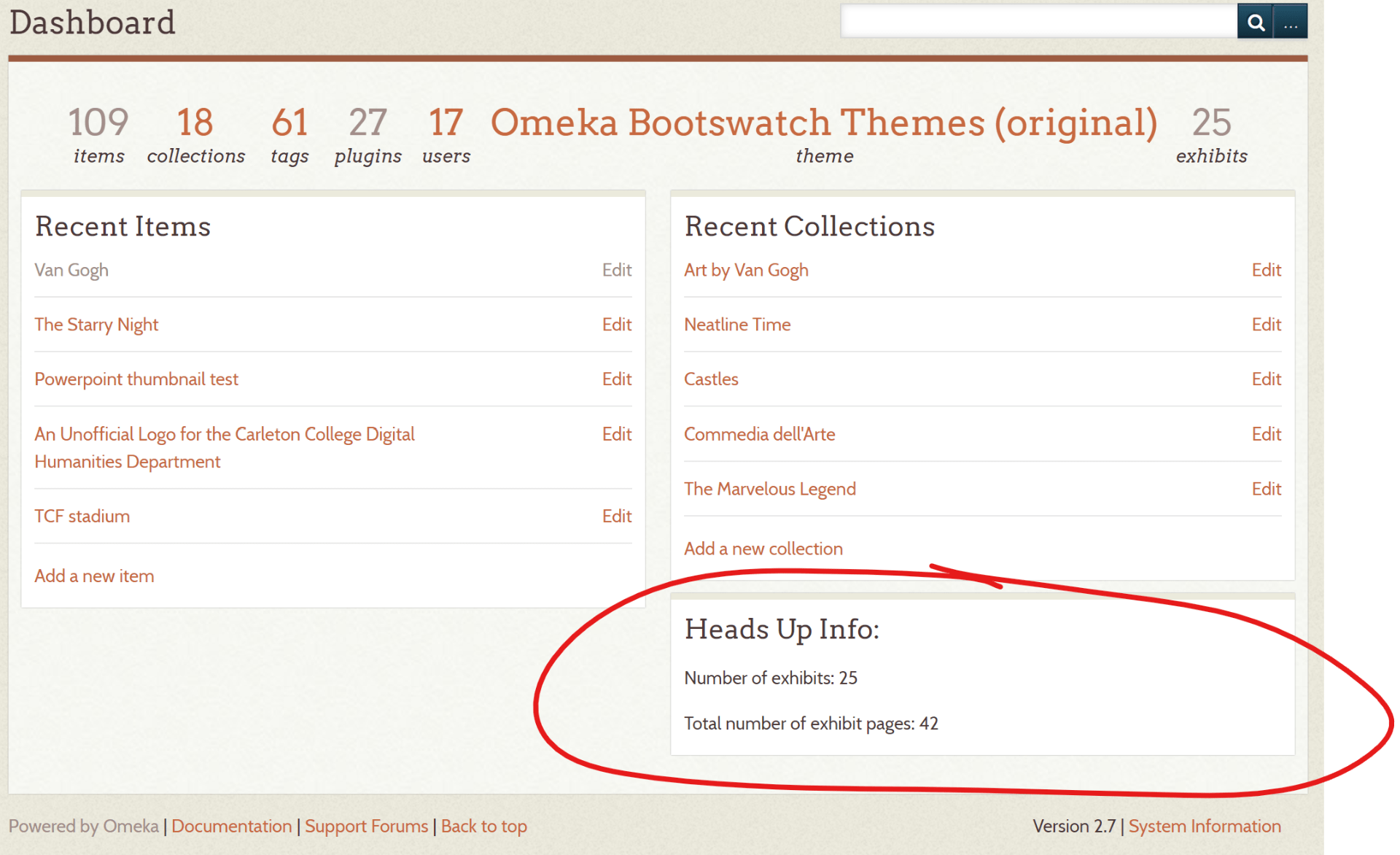
I created a simple heads up display that appears on the dashboard of your Omeka site and displays information about the number of exhibits and pages on the site.

WordPress and Omeka are, at a high level, very similar in the way that they integrate plugins into the regular processing, and the environment they create for them. For background, the way plugin development for content management systems works is roughly as follows: The CMS itself is code written in PHP, parts of which are called every time that a request is made to the server. While the system is processing the request, it periodically makes checks to all the plugins that are installed to see if they have registered any hooks or filters. Hooks are events that fire at specific points during the system’s processing, and they are used by the plugins to perform additional processing at those points. For example, if your plugin adds metadata to every item that is saved to the database, you would register it with a filter that fires whenever data is being set to the database. Your plugin can then take that data, modify it by adding the metadata, and then send it back to the regular processing. Hooks work similarly, but they do not need to pass any data along. They can be used to add content to a page or create additional database entries. WordPress and Omeka both follow this general structure, but there are syntactical differences in the ways that they expect plugins to be formatted and functions to be named. Learning those was pretty straightforward once I understood the basic structure of how plugins work.


The single biggest difference I’ve noticed between WordPress and Omeka plugin development is the level of documentation. WordPress is incredibly well documented, and perhaps more importantly, Stack Overflow questions and answers about common development issues abound. Plugin development for Omeka, especially at a beginner level, is substantially slowed by the lack of effective documentation for built-in functions, hooks, filters, and classes. The Omeka developer documentation provides a minimal reference of the objects that exist, but detailed descriptions and examples on how to use them are lacking. When developing for WordPress, it was easy always easy to Google an issue and quickly find either a section of the WordPress Codex, a forum post or some other resource that answered my question. When working on the Omeka plugins, on the other hand, usually I had to answer my own questions with extensive var_dumps and echo statements. Luckily, it seems as though the core plugin functionality of Omeka, once you understand the MVC structure and some of the quirky hook/filter mechanisms, is fairly consistent and straightforward, so it was usually not terribly difficult to figure out what a function did or what kinds of data were contained in an object.


Over the course of the term, I created a simple heads-up display plugin for both WordPress and Omeka, that each display relevant information about your site. Coding a similar plugin for each CMS side by side allowed me to compare the structure, environment, and documentation surrounding plugin development for both WordPress and Omeka. I also fixed bugs for and extended the functionality of our AccessibilityPlus Omeka plugin. With these changes in place, AccessibilityPlus works with Omeka 2.7, and we should be able to move forward with our contacts at NYU who are putting the plugin to use.

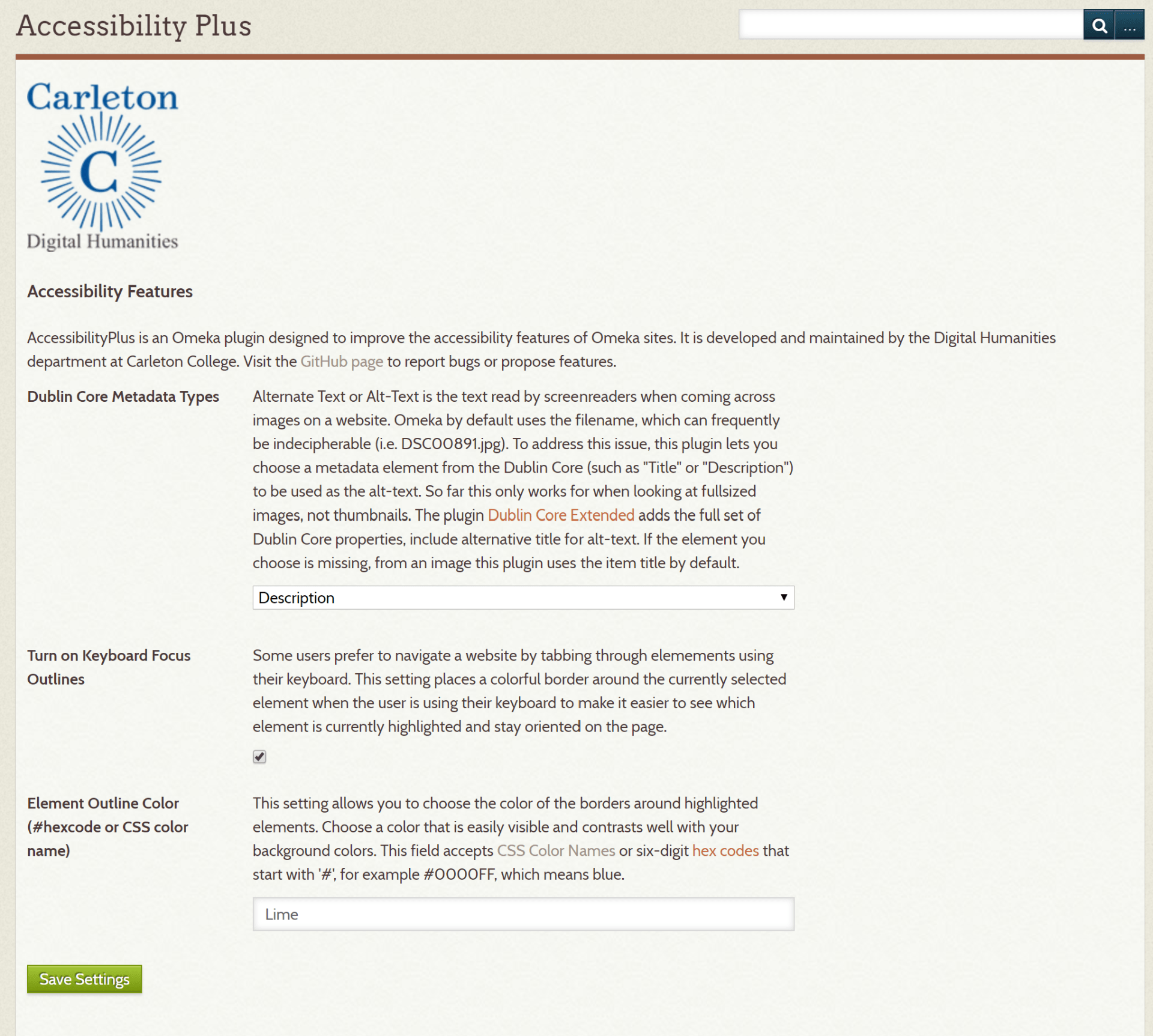
This is the new AccessibilityPlus settings page that I updated to manage the new features for the plugin.

Comparing WordPress and Omeka Plugin Development

Uncategorized

WordPress and Omeka are, at a high level, very similar in the way that they integrate plugins into the regular processing, and the environment they create for them. For background, the way plugin development for content management systems works is roughly as follows: The CMS itself is code written in PHP, parts of which are called every time that a request is made to the server. While the system is processing the request, it periodically makes checks to all the plugins that are installed to see if they have registered any hooks or filters. Filters are events that fire at specific points during the system’s processing, and they are used by the plugins to modify data that is moving through the system at those points. Each filter corresponds to a specific stream of data. For example, if your plugin adds metadata to every item that is saved to the database, you would register it with a filter that fires whenever data is being set to the database. Your plugin can then take that data, modify it by adding the metadata, and then send it back to the regular processing. Hooks work similarly, but they do not need to pass any data along. Instead, they fire at certain points during the systems processing and allow plugins to perform their own processing and make changes at those specific points. They can be used to add content to a page as it is being generated or create additional database entries. WordPress and Omeka both follow this general structure, but there are syntactical differences in the ways that they expect plugins to be formatted and functions to be named. Learning those is pretty straightforward once you understand the basic structure of how plugins work in both cases.


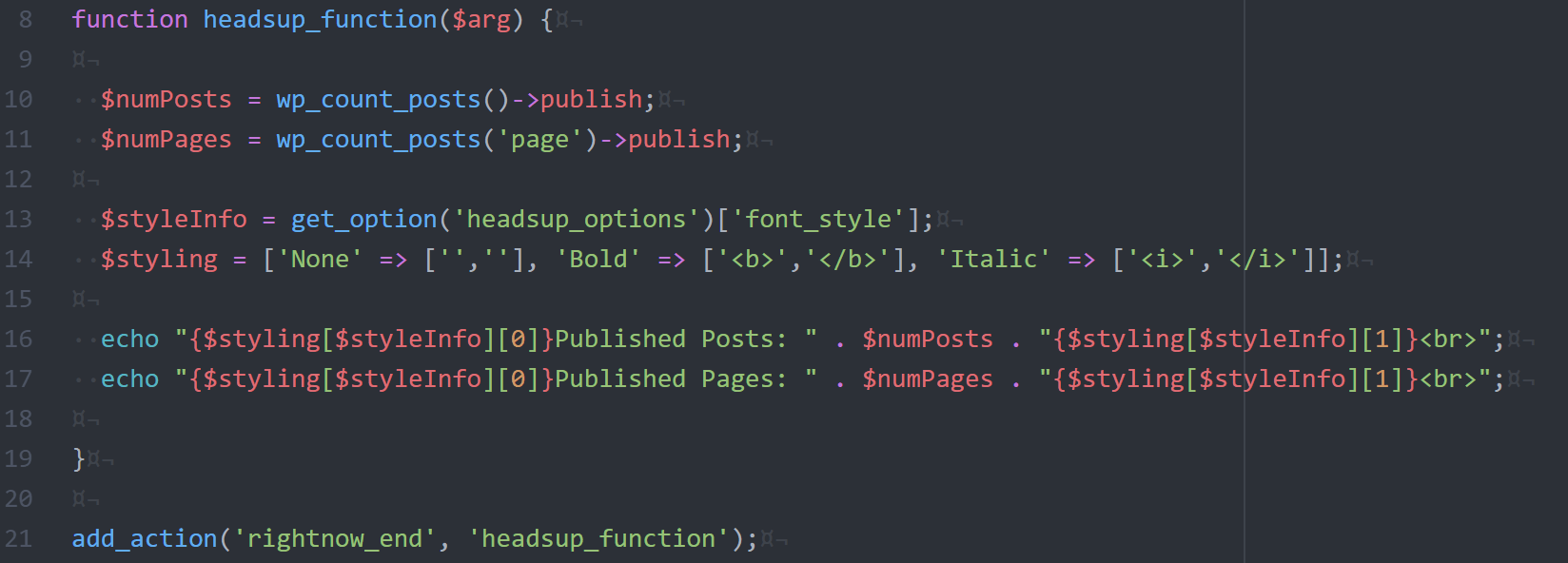
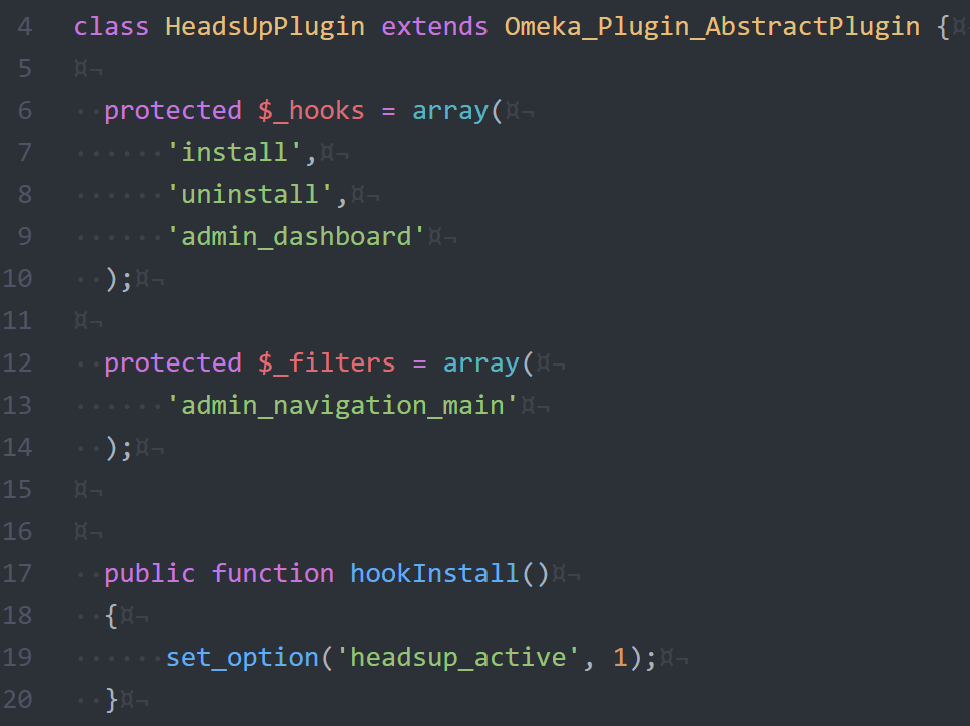
The above images illustrate some of the syntactical differences between WordPress and Omeka, specifically the way in which functions are registered with hooks.

The single biggest difference I’ve noticed between WordPress and Omeka plugin development is the level of documentation. WordPress is incredibly well documented, and perhaps more importantly, Stack Overflow questions and answers about common development issues abound. Plugin development for Omeka, especially at a beginner level, is substantially slowed by the lack of effective documentation for built-in functions, hooks, filters, and classes. The Omeka developer documentation provides a minimal reference of the objects that exist, but detailed descriptions and examples on how to use them are lacking. Often you merely find confirmation that a function you are trying to use exists, without finding any guiding information on how it actually works. When developing for WordPress, it is typically easy to Google an issue and quickly find either a section of the WordPress Codex, a forum post or some other resource that answers your question. When working on the Omeka plugins, on the other hand, you seem to usually end up answering your own questions with extensive var_dumps and echo statements. Luckily, it seems as though the core plugin functionality of Omeka, once you understand the MVC structure and some of the quirky hook/filter mechanisms, is fairly consistent and straightforward, so it is usually not terribly difficult to figure out what a function does or what kinds of data are contained in an object, you just need to be prepared to use a lot of trial and error.

End of Year Bibliography and Reflection

Uncategorized
“Airbnb Teams up with 23andMe to Recommend Heritage Travel Destinations.” VentureBeat (blog), May 21, 2019. https://venturebeat.com/2019/05/21/airbnb-teams-up-with-23andme-to-recommend-heritage-travel-destinations/
Soon, 23andMe customers will be able to click through to their ancestral populations to find Airbnb stays and experiences located in their ancestral countries. On Airbnb there are even designated pages to this crossover. Should your DNA dictate how companies advertise to you? This is a concerning development that pushed the boundaries of access companies have to your personal data. This is a service that seems unnecessary and a complete invasion of privacy.
Baron, Jessica. “Tech Ethics Issues We Should All Be Thinking About In 2019.” Forbes, December 27, 2018. https://www.forbes.com/sites/jessicabaron/2018/12/27/tech-ethics-issues-we-should-all-be-thinking-about-in-2019/#4877ee0d4b21
This article brought new technologies into questions for their ethical implications. For things such as sideway labs, insect allies, and the datafication of children, how much ar ethe consequences being considered? It provides a nice overview of some new technologies and some things that should be thought about more when seriously considering their implementations.
Barrett, Brian. “How A Professional Gambler Broke Jeopardy!” Wired, April 10, 2019. https://www.wired.com/story/jeopardy-record-james-holzhauer-strategy/
A single-player won over one hundred thousand dollars in a single game of Jeopardy. He utilizes a unique strategy to pick the highest-paid questions first and bid all he can at every opportunity. This has been extremely successful so far, so that makes us rethink how players typically play the game. This can be applied to other aspects of life where the current algorithm we use may not be the most effective.
Conger, Kate. “Uber Is Said to Aim for I.P.O. Valuation of Up to $100 Billion.” The New York Times, April 10, 2019. https://www.nytimes.com/2019/04/10/technology/uber-ipo.html
A sale of 90 or 100 billion would make Uber one of the larget American tech companies to go public in recent years. For a company this is still relatively new in the realm of companies, this is a huge accomplishment. This conveys how much the needs and wants of technologies can fill a niche that we don’t even realize we have yet.
Cordelia. “Projectors Don’t Lie.” Salesforce UX (blog), December 30, 2014. https://medium.com/salesforce-ux/projectors-dont-lie-b85ef628b04
This article presented why causes the disparities between the looks of designs on a designer’s laptop and on a projector. I enjoyed this because the websites that I am helping to improve are most likely going to be displayed on personal computers along with projectors in the classroom. Knowing how to avoid many of the problems will be helpful when designing.
“Describing Visual Resources Toolkit – Describing Visual Resources for Accessibility in Arts & Humanities Publications.” Accessed September 26, 2017. https://describingvisualresources.org/
This article discusses the need for accessibility within digital publications. This applies to what we do directly in this program with attempting to make thoughtful designs to spread scholarly information. This is a great overview for anyone working with digital technologies in all areas.
Dewey, Caitlin. “Absolutely Everything You Need to Know to Understand 4chan, the Internet’s Own Bogeyman.” The Washington Post, September 25, 2014. https://www.washingtonpost.com/news/the-intersect/wp/2014/09/25/absolutely-everything-you-need-to-know-to-understand-4chan-the-internets-own-bogeyman/?utm_term=.64caff9018d2
A website “4chan” was brought into question about the ethical problems having anonymous users can create. With the forum allowing all users to post whatever they like, it has created an online community with its own method of communication that is hard to decipher to anyone on the outside. The website reaches just around 22 million users, and with little regulation, how much should we worry?
Feingold, Lainey. “ASKING ABOUT COMPLIANCE? YOU MAY BE ASKING THE WRONG QUESTION.” Law Office of Lainey Feingold (blog), n.d. https://www.lflegal.com/2018/07/ada-28/
This article presented the law surrounding video captioning and how accurate they have to be. Even with this law established, with a rate of only sixty-five percent required, many of the main information trying to be presented could be lost. This misinformation can lead to people that rely on those captions to receive less and even wrong information. The issues presented in this article fostered a need to explore this topic further.
“Firefox Makers Working on Voice-Controlled Web Browser Called Scout – CNET.” Accessed July 3, 2018. https://www.cnet.com/news/mozilla-working-on-scout-a-voice-controlled-web-browser-project/
I chose this article because the idea of a completely voice-controlled web browser sounds fascinating. Instead of it being designed as an alternative for people that need this feature, it wants to be a browser that everyone uses that is also accessible.

.

Flynn, Meagan. “Police Think Alexa May Have Witnessed a New Hampshire Double Homicide. Now They Want Amazon to Turn Her Over.” The Washington Post, November 14, 2018. https://www.washingtonpost.com/nation/2018/11/14/police-think-alexa-may-have-witnessed-new-hampshire-double-slaying-now-they-want-amazon-turn-her-over/?noredirect=on&utm_term=.1dc6685ee4e9
This article asks whether of not Amazon should give the audio recording of a possible murder. Does this violate the First Amendment? With no established laws pertaining to these listening devices, this has happened frequently to other companies such as Apple, Google, and Facebook.
Hern, Alex. “Myspace Loses All Content Uploaded before 2016.” The Guardian, March 18, 2019. https://www.theguardian.com/technology/2019/mar/18/myspace-loses-all-content-uploaded-before-2016
Faulty server migration blamed for mass deletion of users’ songs, photos, and video. Although Myspace does not have the popularity it once had, this still raises concerns for sites we use the most. People rely on technology for documenting and saving moments more than ever before. This serves as a reminder that not every site or app is immune to technology failures.
https://www.facebook.com/washingtonpostopinions. “Opinion | Machines Can’t Quite Crack Shakespeare. That’s a Relief.” Washington Post. Accessed May 23, 2019. https://www.washingtonpost.com/opinions/machines-cant-quite-crack-shakespeare-thats-a-relief/2019/04/28/bad569ea-6854-11e9-82ba-fcfeff232e8f_story.html
People have attempted to program a computer to understand the complexities of the characters in Shakespeare plays. There was a fear that this would take the “human” out of “humanities.” However, it has still yet been able to map the subtle things that make the works so complex. Nothing can currently understand Shakespeare as well as the human reader.
Hunt, Taylor. “The Web Is Made of Edge Cases.” CodePen. Accessed August 15, 2018. https://codepen.io/tigt/post/the-web-is-made-of-edge-cases
This article discusses how many websites are unvisited on the internet. This article was a bit confusing to get the main message because the author seems to jump between topics. I believe it serves as a PSA towards web designers on how to try to be accessible to all users, in order to not exclude people that are trying to use your site and make your site load quickly to avoid timing out. Smart design choices could make the difference toward your site being used or forgotten.
Jesse Hausler. “7 Things Every Designer Needs to Know about Accessibility.” Medium (blog), April 15, 2015. https://medium.com/salesforce-ux/7-things-every-designer-needs-to-know-about-accessibility-64f105f0881b
This article is aimed at the designer to emphasize how incorporating accessible designs into their work should not be seen as a burden. The author conveys that designing for everyone can actually help come up with new ideas, like high contrasting colors for those who are colorblind. They also stress the importance of taking a step back from design to ask if your design can be used by all people. This article will help all web designers to be more aware when they are building new programs.
Johnson, Laura. “Comparing 3 Top Automated Accessibility Testing Tools: WAVE, Tenon.Io, and Google Lighthouse.” Medium (blog), July 24, 2018. https://medium.com/myplanet-musings/comparing-3-top-automated-accessibility-testing-tools-wave-tenon-io-and-google-lighthouse-d3897d7bb311
This article compares the accessibility tools of WAVE, Tenon.io, and Google Lighthouse. This is a great resource for designers looking for which tool to utilize to analyze sites. This could also be used by someone that owns a site that is curious about whether their site is accessible to all users.
Knight, Will. “Google Employees Are Lining up to Trash Google’s AI Ethics Council.” MIT Technology Review, April 1, 2019. https://www.technologyreview.com/s/613253/googles-ai-council-faces-blowback-over-a-conservative-member/
Thousands of Google employees are in protest over the new council Google created for AI ethics. The concern is surrounding a member of the council that is in strong support of Google’s aid in US Military drones. Other notable members in the Computer Science ethics community have declined the role in fear that it would lead astray from the ethical matters that are most important to them.
Manjoo, Farhad. “The Problem With Fixing WhatsApp? Human Nature Might Get in the Way.” The New York Times, October 24, 2018. https://www.nytimes.com/2018/10/24/technology/fixing-whatsapp-disinformation-human-nature.html
WhatsApp is a messaging app used by millions of users that offers end-to-end encryption and the article asks: who should be blamed for actions enacted by WhatsApp messages? One example is the riots surrounding the Brazilian elections and Facebook is claiming minimal responsibility. So should regulation of these technologies be enforced by the company or of the government?
Metz, Cade, and Mike Isaac. “Facebook’s A.I. Whiz Now Faces the Task of Cleaning It Up. Sometimes That Brings Him to Tears.” The New York Times, May 17, 2019, sec. Technology. https://www.nytimes.com/2019/05/17/technology/facebook-ai-schroepfer.html
This article follows an executive after Facebook live-streamed a shooter and his attack. The focus on his emotional response translated to a positive outlook on Facebook’s development of an AI. This AI will add to the content moderation of the site. It is unclear if it scans all posts or just posts that are flagged. The big concern brought up about this article was that the AI is still only reacting to posts once they are already in view on the site and not before which still exposes people to potentially triggering posts.
Newman, Lily Hay. “The Robocall Crisis Will Never Be Totally Fixed.” Wired, April 7, 2019. https://www.wired.com/story/robocalls-spam-fix-stir-shaken/
The number of unwanted calls that are reached to a mass of people is still not under control. Despite this increasing number of robocalls, there is hope that it has reached a plateau. The FCC is implementing changes making it harder for robocall to access numbers. Also, the number of technologies that offering free ways to prevent robocalls is also increasing.
Roose, Kevin. “In Andrew Yang, the Internet Finds a Meme-Worthy Candidate.” The New York Times, March 20, 2019
This article discusses the surge of online politicians and, in particular, Andrew Yang. The popularity for his 2020 presidential campaign has been grown exclusively through the internet. It raises the question of how much technology should play in politics and how much should we be concerned?
Satariano, Adam. “Britain Proposes Broad New Powers to Regulate Internet Content.” The New York Times, April 7, 2019
Britain is seeking to ban extremist and violent content from the internet. Certain sites such as Facebook and Google are being targeted in particular. This follows a trend of governments putting more restrictions on technologies and their content and enforcing them on companies. This may lead to a shift in the power of how all content, not just the extremes, is controlled within the internet.
Sutton, Marcy. “Accessibility Wins, Curated by Marcy Sutton.” Accessed August 15, 2018. https://a11ywins.tumblr.com/
This blog post highlights the various features in major websites that are accessible: such as Wikipedia, Facebook, Expedia, and more niche ones like Nerdery. This can be used as a tool for designers to get inspiration on where accessibility could have been overlooked, but did not. The tools features range over many aspects of front-end in various applications.
“The Cost of Access,” July 7, 2018. https://laurakalbag.com/the-cost-of-access/
This blog asks what is the cost of technology regarding people that need additional assistance. For example, with technologies like Alexa that utilize voice recognition, the demand has increased for those technologies, and people that actually need to use them now have to pay more. I don’t know how much I agreed with this article and because this information is presented in a blog, it raises the question of how bias these options are and how well supported they are with facts so further research on these issues is required.
Tufekci, Zeynep. “We Are Tenants on Our Own Devices.” Wired, May 20, 2019. https://www.wired.com/story/right-to-repair-tenants-on-our-own-devices/
After an incident where Amazon mass deleted copies of “1984” from individuals’ kindles, a concern of a transformation into a tenet society was brought up. Many companies are putting in more complex computer systems into their products that assert their right to fix and upgrade people cannot understand the complexities on their own. People are becoming more and more reliant on devices that they cannot have fully as their own.
“What Happened to the Uber-for-X Companies – The Atlantic.” Accessed May 23, 2019. https://www.theatlantic.com/technology/archive/2019/03/what-happened-uber-x-companies/584236/
Uber started a chain of companies that serve as platforms for sets of people to serve the other. This idea that companies call themselves the “Uber-of” anything conveys their influence. This article brought up the social dynamics that bring back more into popular culture of the servant economy. The people that work for Uber, Lyft, Grubhub, etc seem to work for a multiple of these companies and their livelihood depends on them. The continued expansion of these “Uber-of” seems improbable as the labor needed to fulfill these platforms are not increasing as the demands.
Wilson, Mark. “Pinterest Just Redesigned Its App For Blind People.” Co.Design, April 25, 2018. https://www.fastcodesign.com/90169317/pinterest-just-redesigned-its-app-for-blind-people
Pinterest tested their app to see how people with visual impairments could interact with this app and discovered that almost all of them couldn’t get past the sign-in page. They tried to incorporate read-aloud features but had problems leaving out critical information in things like recipes and users had trouble navigating between pins. They improved the read-aloud features and made it easier for people without mouses to navigate the site. I admire Pinterest for recognizing that changes needed to be made and actually implementing those changes.
Thank you to my mentors for making this a year of growth and learning. I also want to thank my fellow interns for sharing their knowledge in our weekly meetings and hearing their thoughts on ethical issues. I am honored to have been able to combine my love of Computer Science with Digital Humanities to improve the user experience of the websites. This internship sparked a passion for ethics and accessibility that I will carry with me throughout the rest of my career. I hope to continue these studies here at Carleton, and possibly in graduate school later on.

Bibliography

Uncategorized

The following is bibliography of what I read and listened to throughout the year.


1. “#99 Black Hole, New Jersey | Reply All,” Gimlet, accessed June 2, 2019, https://gimletmedia.com/shows/reply-all/5whmxd.

Podcast on a bizarre company that poses as a shipping stop but in reality steals packages and sends them to Europe. Podcast brings to light some of the problems with security and trust over the internet and how it can be hard to recover items and press charges against these types of companies


2. “#104 The Case of the Phantom Caller | Reply All,” Gimlet, accessed June 2, 2019, https://gimletmedia.com/shows/reply-all/n8ho3a.

A massive computer program scapes internet for phone numbers and makes hundreds of thousands of phone calls a day. Uses strange noises to mask calls. Program targets 1-800 numbers. Cost of call is charged to company and then shared with phone companies that helped connect this call. The software was traced back to a scam company that would always play a small part in these calls, therefore earning money.


3. “#109 Is Facebook Spying on You? | Reply All,” Gimlet, accessed June 2, 2019, https://gimletmedia.com/shows/reply-all/z3hlwr.

Interesting podcast that did a good job of highlighting people’s fears with facebook and there reasoning for why they think they are seeing targeted adds. After listening, I am still convinced that facebook is in fact not using mobile devices to listen to conversations.


4. “#112 The Prophet | Reply All,” Gimlet, accessed June 2, 2019, https://gimletmedia.com/shows/reply-all/j4hl36.

This podcast does a good job of highlighting some of the issues around using social media as a platform for mass bullying.


5. “#115 The Bitcoin Hunter | Reply All,” Gimlet, accessed June 2, 2019, https://gimletmedia.com/shows/reply-all/z3hl9r.

Super Tech Support episode that delves into some of the problems with crypto and how difficult it can be to track it and access it if you lose a password.


6. “#123 An Ad for the Worst Day of Your Life | Reply All,” Gimlet, accessed June 2, 2019, https://gimletmedia.com/shows/reply-all/8whoek.

I had always wondered who was responsible for the clickbait ads and why they are a thing. Through this podcast I discovered that there a two main companies that are responsible for almost all of the clickbait adds we see on the internet which is absurd. I also found it interesting to learn about the payment structure between these add companies and the websites (like new york times) that display them.


7. “#127 The Crime Machine, Part I | Reply All,” Gimlet, accessed June 2, 2019, https://gimletmedia.com/shows/reply-all/o2hx34.

Part one of a podcast that tells the origin story of the system used by the NYPD to lower the crime rate in NYC. One of the effects of this system is increased racial profiling and ticket quotas.


8. “#128 The Crime Machine, Part II | Reply All,” Gimlet, accessed June 2, 2019, https://gimletmedia.com/shows/reply-all/n8hwl7.

Part two of a podcast that tells the origin story of the system used by the NYPD to lower the crime rate in NYC. One of the effects of this system is increased racial profiling and ticket quotas.

9. “#130 The Snapchat Thief | Reply All,” Gimlet, accessed June 2, 2019, https://gimletmedia.com/shows/reply-all/v4he6k.

This podcast takes a dive into the blackmarket hacking world of social media accounts. Hackers use weaknesses in phone number security and the obliviousness of servuce providers as an entry point into getting login information. Hackers then either hold this info for ransom, black mailing, or selling to other hackers


10. “#135 Robocall: Bang Bang | Reply All,” Gimlet, accessed June 2, 2019, https://gimletmedia.com/shows/reply-all/awhk76.

Interesting podcast that details the rise of robo calls. This was my first introduction into how insecure phone numbers are and how easy it is for companies to track your location via a phone number.


11. “#136 The Founder | Reply All,” Gimlet, accessed June 2, 2019, https://gimletmedia.com/shows/reply-all/dvhd9k.

This podcast talks about a relatively unknown person who used the internet to commit crimes on a global scale. He starts in the black market pharmaceutical business and eventually hires his own private army and hitman. Eventually this leads to his downfall.


12. “#138 The Great Momo Panic | Reply All,” Gimlet, accessed June 2, 2019, https://gimletmedia.com/shows/reply-all/j4h6jd.

social media craze where digital figure convinces children to do things. Eventually leads to digital figure “momo” telling children to commit suicide. Podcast brings up questions on how to protect children in the age of social media. It seems like there is fine line between using social media to benefit your children vs having it harm them. How do parents makes this decision?


13. “#140 The Roman Mars Mazda Virus | Reply All,” Gimlet, accessed June 2, 2019, https://gimletmedia.com/shows/reply-all/brh8jm.

silly podcast that bring up an interesting problem. Certain podcasts are unable to be played in a particular car because of characters in the title of the podcast. These problamatic characters cause the program playing the podcast to crash and make the episode unplayable.


14. “#141 Adam Pisces and the $2 Coke | Reply All,” Gimlet, accessed June 2, 2019, https://gimletmedia.com/shows/reply-all/z3hgd2.

This podcast talks about a problem plagueing dominoes stores across the U.S. Mysterious online orders under the name “Adam Pisces” for $2 coke come into stores across the U.S. It is unknown what the cause of this is. Some people think they are coming from hackers that are testing dominoes internal security for weaknesses, some think its credit card thiefs testing stolen cards, while others think it is coming internally from Dominoes.


15. “#142 We Didn’t Start The Fire | Reply All,” Gimlet, accessed May 26, 2019, https://gimletmedia.com/shows/reply-all/gmhr36.

Podcast talks about multiple things happening in the world specifically inside jokes happening on social media. The group deciphers a confusing tweet that references things happening in deep internet culture.


16. Jonathan Albright, “#Election2016: Propaganda-Lytics & Weaponized Shadow Trackers,” Medium (blog), November 22, 2016, https://medium.com/@d1gi/election2016-propaganda-lytics-weaponized-shadow-trackers-a6c9281f5ef9.

This article details an experiment into news sites and how insecure they are. The author of this article wrote a program that visited over 100 news sites that had interest in the 2016 election and scraped the mechanisms that were tracking peoples navigation of them. He found that many of these sites are not safe and held a lot of third-party software trackers that could easily be used by others for nefarious reasons.


17. Jesse Hausler, “7 Things Every Designer Needs to Know about Accessibility,” Medium (blog), April 15, 2015, https://medium.com/salesforce-ux/7-things-every-designer-needs-to-know-about-accessibility-64f105f0881b.

A great introductory article into some of things keep in mind when design accessible web applications. Some of the key takeaways from this article were do not use color as the only way to convey a certain piece of information. Be wary of building forms. The biggest takeaway was the that accessibility is not a barrier to innovation.


18. Lily Hay Newman, “Facebook Broadens Its Bug Bounty to Help Fix Third-Party Apps,” Wired, September 17, 2018, https://www.wired.com/story/facebook-bug-bounty-third-party-apps/.

This article gives a brief history of Facebooks bug bounty program which launched in 2011 and details a new initiative that will allow researchers to submit vulnerabilities in the third-party apps that it uses. Reading this article made me ask the question: Why has it taken 7 years for this become a thing? It seems like this addition to the program is in response in the Facebook’s recent bad press rather than step they took on their own. The article also mentions that they will only accept submissions that were found while passively using a third-party service. This means that vulnerabilities uncovered through malicious activity (a very common way to discover  vulnerabilities) will not be accepted. To me it seems like they could be doing more.


19. “Facebook’s A.I. Whiz Now Faces the Task of Cleaning It Up. Sometimes That Brings Him to Tears. – The New York Times,” accessed May 26, 2019, https://www.nytimes.com/2019/05/17/technology/facebook-ai-schroepfer.html.


This article describes the story of Facebook’s Mike Schroepfer the current CTO of facebook. It goes into detail on his journey through the ranks of facebook and some of the things he has been a part of and some things he has been responsible for. It also goes into depth on his reaction to facebook being used to post violent disturbing content and how much of an effect it has had on him. What is the main goal of this article?


20. “Google’s New Voice Recognition System Works Instantly and Offline (If You Have a Pixel),” TechCrunch (blog), accessed April 22, 2019, http://social.techcrunch.com/2019/03/12/googles-new-voice-recognition-system-works-instantly-and-offline-if-you-have-a-pixel/.

This article is about NLP and google’s new voice recognition system for its pixel phone. Google came up with a way from their voice system to work instantly. This is an important breakthrough in NLP because network latency is one of the things that has been holding innovation back in this sector of NLP.


21. “How to Implement Inclusive Design in Your Organization,” Adobe Blog (blog), July 10, 2018, https://theblog.adobe.com/how-to-implement-inclusive-design-in-your-organization/.

This article lists ways to create an inclusive work environment. some of the key reasons include making inclusion a priority and hiring inclusively.


22. “Https://Www.Shopify.Com/Partners/Blog/Why-and-How-to-Improve-Ecommerce-Website-Accessibility,” n.d.

Article discusses ecommerce and some of the accessibility problems that exist with this type of internet platform. Also goes into detail on ways to fix this and reasons for doing so.


23. “The Political and Ethical Problems of 5G Internet – The Politicalists – Medium,” accessed May 26, 2019, https://medium.com/the-politicalists/the-political-and-ethical-problems-of-5g-internet-7c5ab0ba9458.

Article pairs well with the Huawei article. This one talks about some of the ethical implications of moving to 5G. Which areas of the country will get 5G first. What kind of an advantage does this provide?


24. “The Real Reason America Is Scared of Huawei: Internet-Connected Everything – MIT Technology Review,” accessed May 26, 2019, https://www.technologyreview.com/s/612874/the-real-reason-america-is-scared-of-huawei-internet-connected-everything/.

Interesting article that talks about 5G and why adoption of it may be a problem for the U.S. The Chinese company Huawei has a monopoly on the production of phones which would be one of the primary devices used to implement 5G. Huawei has been accused by the U.S for selling information to the Chinese government. This is poses an interesting problem for the U.S regarding technological infrastructure


25. Alexis C. Madrigal, “The Servant Economy,” The Atlantic, March 6, 2019, https://www.theatlantic.com/technology/archive/2019/03/what-happened-uber-x-companies/584236/.

It was interesting to think about this business model after Uber (the company that inspired this movement) went public with their IPO. I think a lot of times it is lost on people that we only hear about the companies that work and there are tens and tens of companies that followed the uber model that failed miserably. It was also a helpful thought experiment to think about who benefits from this type of business. Users? Drivers? Company execs?


26. Mightybytes, “What Is Sustainable Web Design?,” accessed April 14, 2018, https://sustainablewebdesign.org/.

It’s nice how sustainable practices actually benefit your website because your making your website run faster, act smoother, and be easier for users. This reminds me of how jobs and environmental practices also go hand in hand despite the fact people often see them as opposing. Doing the right thing–being sustainable–doesn’t have to be a burdan: it can actually act as a guiding tool to improve your design. Knowing of these practices and understanding taking the time to build a better UX is worthwhile for both users and the environment is good to keep in mind as I continue web development.


27. “Why Web Accessibility Should Be a Priority Now: 3 Stats to Prove It,” Siteimprove, accessed October 18, 2018, https://siteimprove.com/en-us/blog/why-web-accessibility-should-be-a-priority-now-3-stats-to-prove-it/.

Article gives three big reasons for why web accessibility should be a priority right now. 1) The worlds aging population is expected to triple by 2050. 2) mobile screen reader usage has increased by 70%. 3) 23% of accessibility litigation has happened in the last year.
End of Year Reflection

Uncategorized

As the year comes to an end, it is time to reflect on the journey I have had as the Accessibility Intern on the Digital Scholarship team at Carleton College. I came into the year knowing virtually nothing about accessibility but being excited to learn about the field. This year I have had the opportunity to learn about a fascinating variety of topics related to accessibility in tech, ethics, as well as information security.

In the Fall, I built foundational knowledge in internet accessibility. I gained this knowledge through investigating and evaluating off-the-shelf accessibility tools such as WAVE as well as parsing the Web Content Accessibility Guidelines (WCAG). Combining this exploration with discussions with my supervisor Celeste Sharpe cemented my understanding of the issues that are plaguing this field as well as what some of the potential solutions are. To cap off the term, our intern cohort used the knowledge we had attained throughout the term to create a detailed comparison between Content Management Systems and Static Site Generators. This exercise gave me a sneak peak of what practical use of accessibility principles looks like in real world systems.

As Winter rolled around I transitioned from less of a research role to more of an application role. I worked on two big projects this term: exploring MediaKron and evaluating 21st Century Artivism. The MediaKron project was in collaboration with Boston College and gave me the chance to see more advanced uses of accessibility within content management systems. I also learned about some of the trade offs associated with building software with a small team and how the best decision is often times not the decision that gets made for any number of reasons (money, time, resources, etc…). With the 21st Century Artivism project, Chris Padilla and I were able to evaluate a current web project on campus and give suggestions for how to improve accessibility and usability.

In the Spring, I was in charge of my own project to explore the differences between AR experiences on wearable devices (Hololens) vs tablet devices. As part of this project, I spent a lot of time programming within Unity trying to build experiences. While I was not able to accomplish my goal, I learned a lot about the difficulties of using proprietary software and some of the downfalls with the current workflow used to develop AR projects for Microsoft Hololens.

I learned so many interesting and valuable things this year. Lessons that I will take with me from Carleton and use professionally in my life after Carleton. I’ve learned so much about the ethical issues that come with this industry and because of this internship I feel prepared to try and solve them in my future endeavors.


End of Year Blog Post

Uncategorized

This year I have covered a lot of ground, researching a variety of different fascinating subjects and learning important technical skills. In the fall, I learned how the basic infrastructure of the internet functions, while the intern cohort conducted an investigation into the specs, usability, accessibility, and ethics of popular content management systems and static site generators. With the research I conducted in the fall, I was able to write a blog post surveying some of the ethical and security issues surrounding web development as a whole. As a part of this blog post, I created infographics that model the information exchange that happens when a web browser requests a resource from a dynamic content management system, vs. a static site generator.


As a part of learning how the infrastructure of the internet works, I became familiar with basic HTML, CSS, and JavaScript. This familiarity helped me dive into a winter break externship project designing web-based scheduling software for a non-profit equine facilitated psychotherapy facility, which is a project I’ve been working on ever since. As a final group project at the end of fall term, the other interns and I migrated the Digital Scholarship Interns blog from WordPress to the static site generator Jekyll. Although we never ended up fully adopting the new system, it was a valuable experience to fully and successfully migrate the blog from one platform to another, and document the whole process so that it could be repeated if necessary by future interns.


When winter came along, I started diving into learning about security and ethics in digital systems. Although this is still a field I hope to learn a lot more about, I started gaining exposure and familiarity to security principals in Linux and web servers. For the first group project of the term, I drafted and finalized a project proposal with Chris Tordi to revitalize a faculty member’s website that had outgrown its original design. Once that was done, Chris and I began exploring the exciting field of AR, and brainstorming ways we could get involved with AR development on campus. At the end of winter term and into the spring, I developed my project proposal for the “Ethical Considerations for AR/VR Apps” report, which became a central focus of mine during the spring.

This spring, I finished my augmented reality report, during which time I also conducted plenty of research into virtual reality uses in police training, augmented reality development platforms, and, separately, some of the rights and policies laid out in the EU by the GDPR.


Overall, a large theme of this year for me has been learning how to conduct internet research into new, volatile, and sometimes controversial topics. From Gamergate to cybersecurity to augmented reality and beyond, I’ve gained valuable knowledge of current technology issues, and gained experience with drafting research proposals, documenting sources, and synthesizing information into concise and coherent reports. This experience combined with the new technological literacy and coding skills I’ve learned has made this year incredibly productive and beneficial for me.